The after-school corner nobody is shopping for
Everyone is buying backpacks this month. The bag gets about eleven minutes a day. The afternoon gets four hours — and nobody is selling you the afternoon.
Walk into any shop this month and it is all first day. Backpacks, shoes, the pencil case with the thing on it, a wall of lunch boxes in a color scheme. All of it aimed at one morning in August that will be over by nine o'clock.
Nobody is selling you the afternoon. And the afternoon is the part you actually live in — the bag dropped exactly where the bag gets dropped, the shoes somewhere else entirely, the reading folder that has to be signed tonight and cannot be found. Four hours a day, five days a week, until June.
You have not missed your window
Here is the good news, and it is the whole reason I am writing this in July rather than September: none of this sells out. There is no panic. Nobody is going to tell you the storage bins are gone by Tuesday or that you should have ordered the shelf in June.
Which means you can do the thing that actually works — put the bones in now, then wait two weeks into the school year before you finish it. You cannot design around a routine you have not met yet. Last year I built a beautiful homework station in August and by October it was where we kept the recycling, because it turned out my granddaughter does her reading on the kitchen floor next to the dog and no shelf was ever going to change that. Set up the frame, live in it for two weeks, then buy the last two things once you can see what genuinely piles up.
01Start where the bag already lands
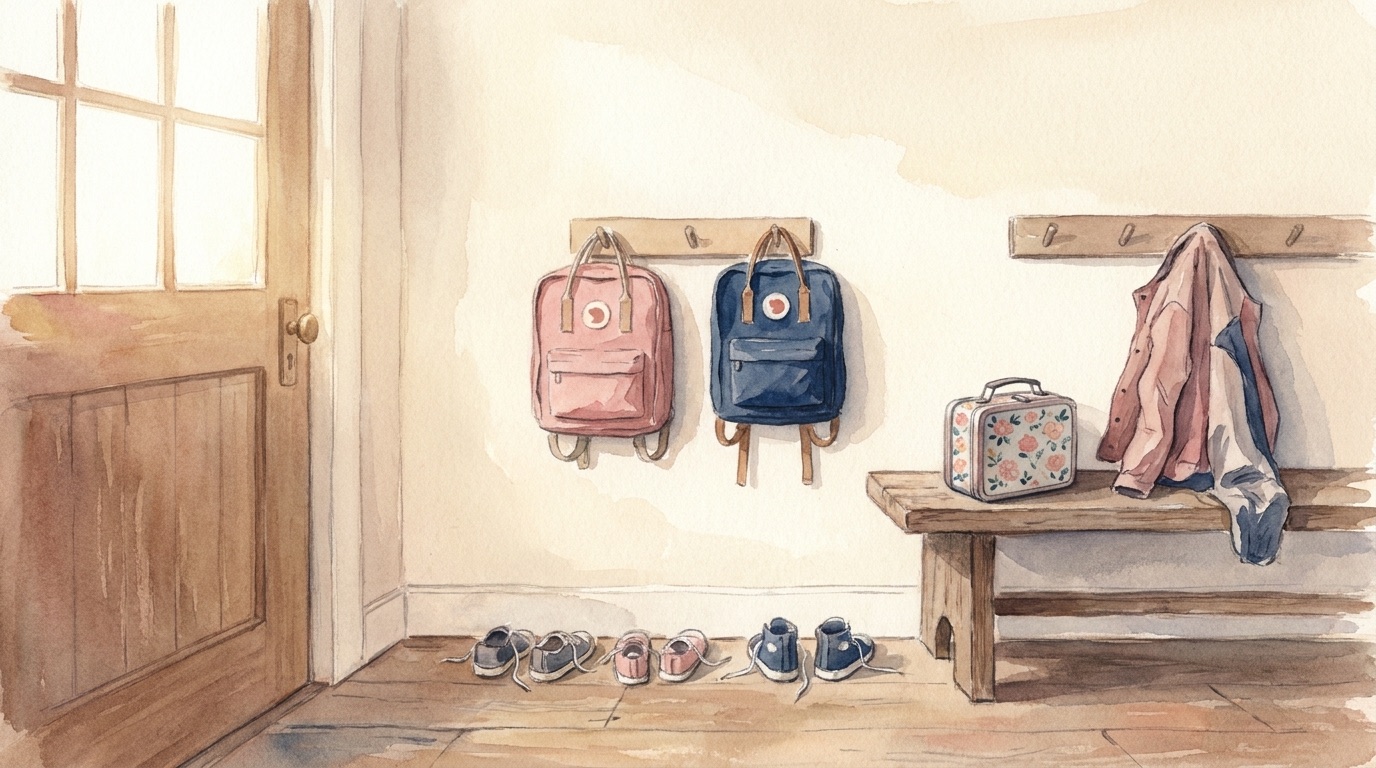
Every house has a spot where the bag goes down. Not the spot where you would like it to go — the actual spot, three feet inside the door, usually in the way. Do not fight it. That negotiation is unwinnable and you will lose it every day for nine months. Put the corner there instead.
It wants two things: something at their height to hang a bag on, and a low shelf that gives everything else an address. A couple of low hooks will do the first job. The shelf does the rest, and it is the one piece worth choosing properly, because everything after this hangs off it.
02One bin each, with their name on it
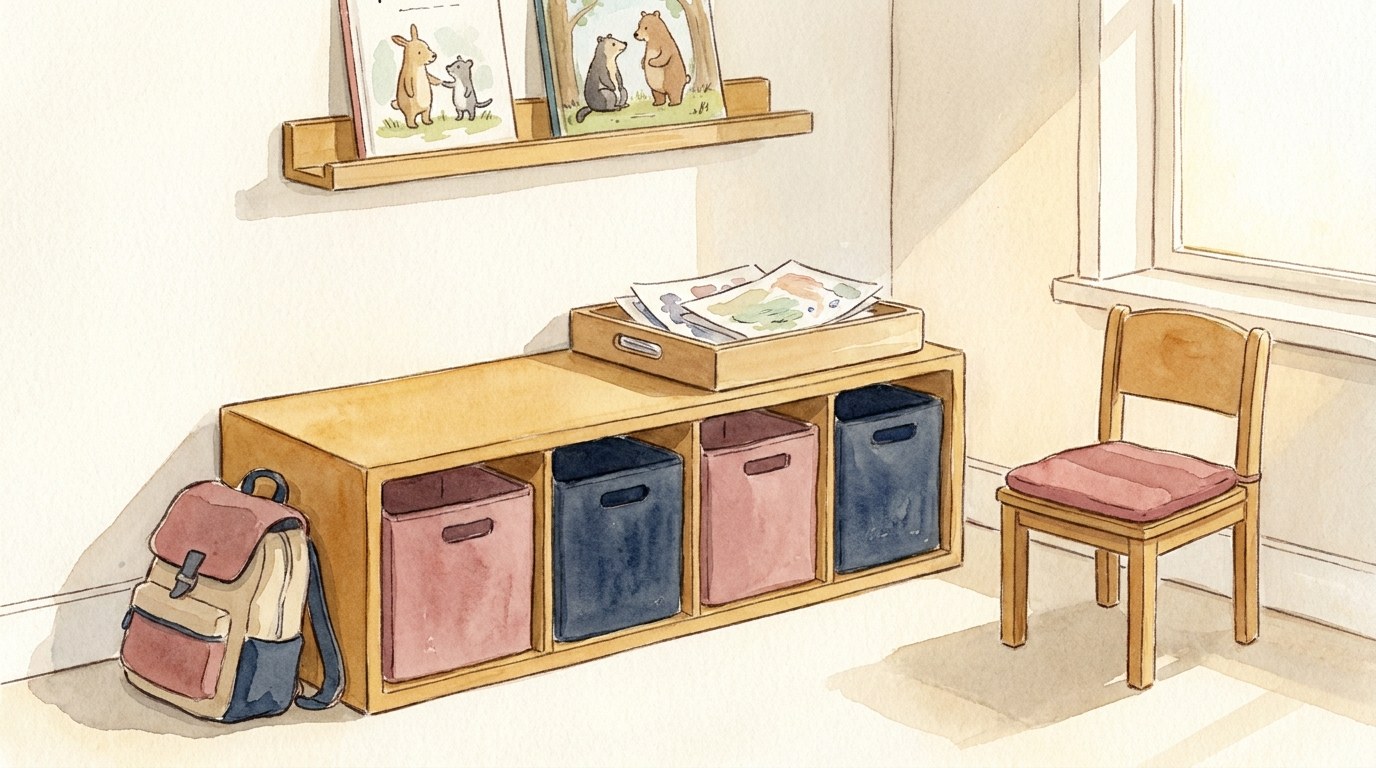
The rule that made ours work: every child gets exactly one bin, and everything school-shaped that comes into the house goes in their own. Not a system. One box, one name.
The magic is not tidiness — it is that 'where is my thing' stops being my problem and becomes a place they can look. And when the bin will not close, that is the signal to sit down together and clear it out, which is a far easier conversation than one about the whole house.
03The paper problem is the real problem
Nobody warns you about the paper. A small forest comes home in that bag every single week — the newsletter, the permission slip, the painting of what might be the dog, the form that needed signing yesterday. It lands on the kitchen counter and it stays there, and by half term the counter is gone.
One shallow tray fixes most of it. Everything paper goes in the tray on the way past. Once a week, on a night you choose, the tray gets emptied: sign it, bin it, or keep it. Three options, no fourth. The keepers go in the memory box; the rest goes without ceremony and without guilt, because you cannot keep all of it and pretending otherwise is how the counter disappears.
You cannot design around a routine you have not met yet.
04Homework that comes to the table
I gave up on the idea of a desk thirty years ago and I have not changed my mind since. They do their homework where the people are, which is the kitchen table, and every attempt to move them somewhere quieter and more sensible fails within a week.
So the supplies travel instead. A small rolling cart lives in the corner, comes to the table at five, and goes back at six — which also means the table gets cleared, because the pencils have somewhere to be.
05Books facing out, not spine out
A small thing that does more than it should. Children choose books by the cover, so a shelf of spines is, to a five-year-old, a wall. Two narrow ledges at their height with six or eight books facing forward, swapped every few weeks, and reading stops being something you remind them about.
Here is mine, itemized
Ours grew out of the craft corner — the same idea aimed at afternoons rather than homework: everything at a height they can reach, so clearing up is something they can do without me. Tap any number to see what it is.
Ten things, about $210 all in. See the full room, itemized →
None of this makes the afternoon calm. There are still ten loud minutes after the door opens where everybody needs something at once and nobody can find it. But a corner with a few addresses in it means those ten minutes are about a snack and a story from the playground, rather than about a folder.
Put the shelf in now, while nobody is rushing you. Buy the last two things in October, when the year has told you what it actually wants.
Everything for the first day
Our hand-picked back-to-school edit — bags, first-day outfits, labels and keepsakes, plus the independent boutiques that stock them.